
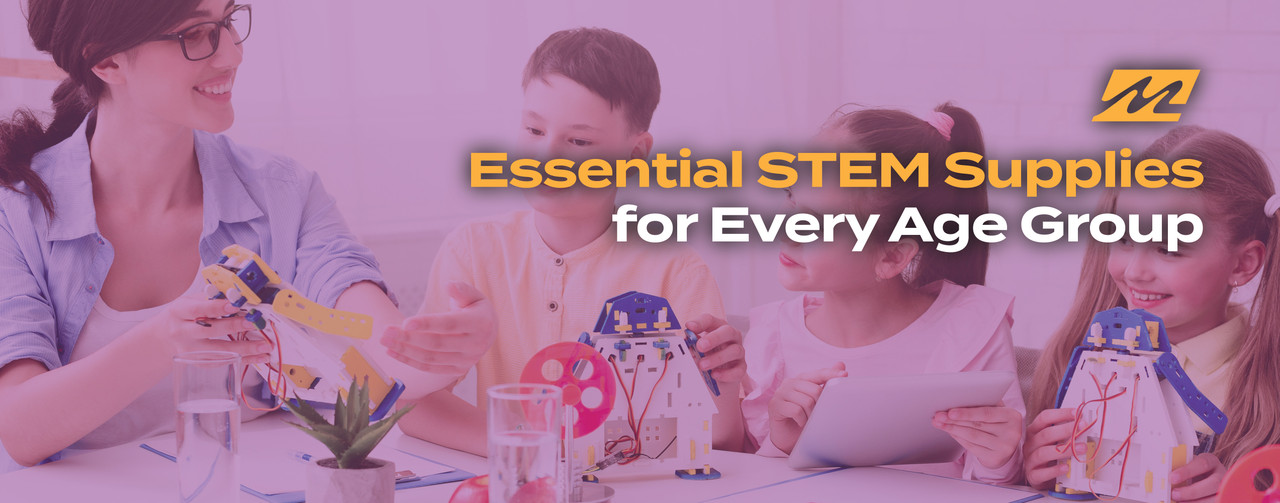
The appropriate STEM supplies for your classroom will depend on the age group you’re teaching and the goals you’ve set for them. Some supplies may be as simple as LEGOs, cardboard, and straws, while others may be more involved like robotics supplies or specific STEM equipment. You can often source simple STEM supplies as donations from parents, though more advanced technology supplies and kits will likely need to be purchased. This guide helps break down the best STEM supplies for each grade level, but don’t be afraid to branch out depending on your PBL or NGSS needs.
Elementary School STEM Supplies
Elementary STEM classrooms benefit from supplies that encourage hands-on exploration, creativity, and problem-solving while remaining accessible to young learners. Building materials such as LEGOs, K’NEX, Magformers, Strawbees, KEVA, and 3DUX give students opportunities to experiment with structures, balance, patterns, and simple engineering concepts. Everyday materials—including cardboard, craft sticks, straws, pipe cleaners, paper cups, rubber bands, and tape—can also become valuable STEM tools for design challenges and PBL activities. These inexpensive supplies are particularly useful for challenges that ask students to design, build, test, and improve a solution.
As students develop more confidence with technology, elementary STEM supplies can introduce basic electronics, coding, and robotics concepts. Squishy Circuits and Snap Circuits make it easier for younger students to explore electricity and circuitry through hands-on projects, while Ozobot and Finch can introduce coding, robotics, and computational thinking in an engaging way. Makey Makey and Hummingbird encourage students to combine coding with physical creations, allowing everything from cardboard inventions to conductive objects to become interactive projects. Bloxels is another engaging option for introducing coding, game design, and storytelling while encouraging students to think creatively and solve problems.
The most effective elementary STEM supply collection does not need to include every possible technology or kit. A combination of open-ended building materials, simple electronics, coding tools, and reusable classroom supplies gives students opportunities to practice the engineering design process across a wide range of activities. Teachers can also supplement purchased materials with donated recyclables and craft supplies, keeping costs manageable while giving students plenty of opportunities to design, build, test, and improve their ideas.
Middle School STEM Supplies
A strong middle school STEM classroom should give students more opportunities to design, test, troubleshoot, and refine their ideas while introducing more advanced technology supplies and engineering concepts. Building materials such as LEGOs, K’NEX, and KEVA remain valuable for structural challenges and open-ended engineering projects, while recycled materials such as cardboard, plastic bottles, string, rubber bands, craft sticks, and cups can provide inexpensive options for design challenges.
As students become more comfortable with technology supplies, tools such as Makey Makey, Snap Circuits, and Cubelets can introduce electronics, circuitry, coding, and robotics supplies in approachable ways. The Wonder Workshop Dash robot can help students build programming skills through hands-on robotic challenges, while Arduino and Raspberry Pi provide pathways into more advanced electronics, programming, and invention projects.
STEM classrooms can also incorporate practical science and math tools such as microscopes, magnifying glasses, rulers, scales, and calipers for experimentation and measurement, along with 3D printers for developing digital design and prototyping skills. For students interested in aerospace and engineering, Estes rocketry supplies can turn STEM concepts into hands-on projects involving design, physics, testing, and data collection.
A well-rounded middle school STEM supply collection does not need to include every available technology; instead, a combination of construction materials, electronics supplies, robotics supplies, coding tools, and traditional science equipment can support increasingly complex projects while giving students opportunities to collaborate and solve real-world problems.
High School STEM Supplies
High school STEM classrooms can benefit from supplies that challenge students to apply advanced concepts, work with real-world technologies, and develop solutions to increasingly complex problems. While basic building materials can still have a place in high school projects, students are ready for more sophisticated equipment such as 3D printers, laser cutters, CNC machines, robotics systems, and electronics. Brands such as Makeblock offer tools that combine coding, robotics, engineering, and automation, while xTool provides laser cutting and engraving technology that can support prototyping, design, and fabrication projects. These tools give students experience with technologies they may encounter in college, technical programs, and future careers.
High school STEM supplies can also provide opportunities to explore energy, sustainability, and emerging technologies. Fuel cell kits and other renewable energy kits from brands such as Thames & Kosmos can help students investigate concepts related to hydrogen power, solar energy, wind energy, and alternative fuel sources through hands-on experiments. 3D printers can take these lessons further by allowing students to design, prototype, test, and revise physical components for their projects. Robotics supplies, microcontrollers, sensors, and programmable electronics can likewise be incorporated into engineering challenges that require students to combine hardware and software to create functional solutions.
At this level, STEM supplies should support more than simply following instructions or completing a predetermined project. The best equipment gives students room to make design decisions, troubleshoot problems, collect data, and improve their work through multiple iterations. A combination of digital fabrication tools, robotics and electronics, renewable energy kits, and engineering materials can help high school STEM programs create authentic PBL experiences while building technical skills that connect classroom learning to college, career, and real-world applications.
STEM Supplies from Midwest Technology Products
A well-equipped STEM classroom gives students the tools they need to explore ideas, solve problems, and turn creative concepts into working solutions. Finding the right supplies is easier when educators have a knowledgeable partner who understands the unique needs of school STEM programs. With a wide selection of STEM equipment, kits, technology supplies, and hands-on materials, Midwest Technology can help educators find the right products for their classrooms and budgets.
Just as importantly, Midwest Technology provides the personal service that can make school purchasing easier. When educators call or email, they connect with a real person—not an AI assistant—who can help answer questions, find products, and provide recommendations. The Midwest team also handles the paperwork from quote to shipping, helping simplify the purchasing process and save educators valuable time. Whether a classroom needs a few new STEM kits or a complete collection of equipment for a growing program, educators can count on Midwest Technology for the products and personal service needed to bring hands-on STEM learning to life.