
3D printing has become an increasingly valuable tool for classrooms, makerspaces, STEM education, and CTE programs. Rather than simply teaching students about how products are designed and manufactured, 3D printers give students the opportunity to turn digital ideas into physical objects. From prototypes and models to functional parts and creative projects, 3D printing can support hands-on learning while helping students develop skills in design, problem-solving, engineering, and technology.
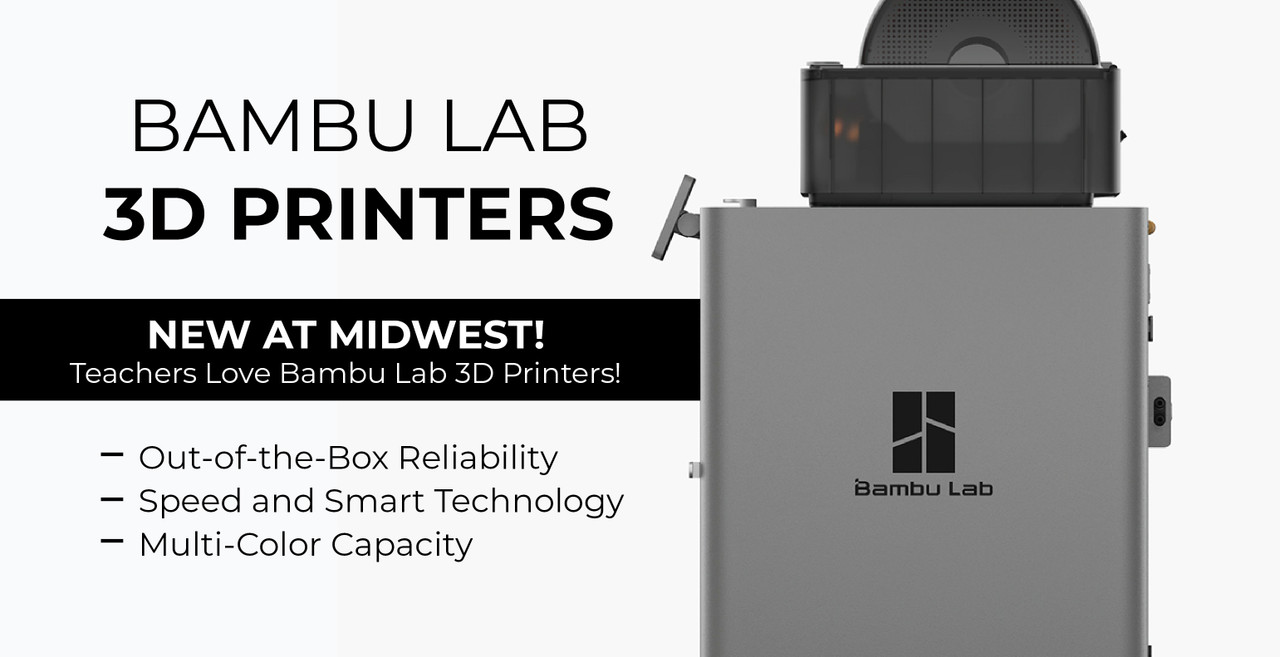
With so many 3D printers available today, choosing the right machine for a classroom can be challenging. Bambu Lab has earned attention in the 3D printing industry with award-winning printers that combine ease of use, advanced features, and versatile printing capabilities. With 4 machines available at different price points, Bambu Lab offers options for educators with a variety of classroom needs and budgets.
What is Fused Deposition Modeling?
Bambu Lab 3D printers use Fused Deposition Modeling (FDM), one of the most widely used 3D printing technologies. FDM printers create objects by depositing melted filament, layer by layer, according to a digital design. As each layer is added, the printed object gradually takes shape.
FDM is particularly well suited for educational environments because it provides students with a practical introduction to additive manufacturing. Students can learn how digital designs are translated into physical objects while experimenting with different shapes, sizes, materials, and design concepts. This makes an FDM 3D printer a useful addition to engineering, technology, STEM, drafting, robotics, and makerspace activities.
Why Choose Bambu Lab 3D Printers?
One of the biggest advantages of the Bambu Lab lineup is its combination of accessibility and advanced functionality. Four different machines are available, providing educators with choices across a range of price points. This makes it easier for schools to select a printer that fits their available budget while still gaining access to the Bambu Lab ecosystem.
Bambu Lab printers also feature servo extruder technology designed to provide precise control during the printing process. This precision can help support consistent, detailed prints, which is especially useful when students are creating prototypes or detailed models.
Another standout feature is the ability to print with multiple colors and, on compatible machines and setups, multiple materials. Multi-color printing can make student projects more visually engaging and help distinguish different components of a model. Multi-material capabilities can expand the types of projects students can create and provide additional opportunities to explore how different materials perform in a finished design.
Easy-to-Use Controls for Educators and Students
Ease of use is an important consideration when selecting technology for a classroom. Bambu Lab printers feature touchscreen controls that provide an intuitive way to interact directly with the machine. Straightforward controls can help reduce the learning curve for students who are new to 3D printing while giving educators convenient access to printer functions.
Bambu Lab also offers mobile and PC apps, giving educators additional ways to interact with their printers. Having multiple control options can make it easier to incorporate 3D printing into classroom activities and manage projects without relying exclusively on the printer's built-in interface.
3D Printing for Hands-On Learning
The value of a classroom 3D printer extends beyond the finished object. The design and printing process itself can become an important part of the learning experience. Students can develop an idea, create a digital model, print a prototype, identify problems, make adjustments, and print again. This iterative process introduces students to practical design thinking and demonstrates how real-world products can evolve through testing and refinement.
Bambu Lab printers can support these types of projects across a wide range of educational applications. Students might create engineering prototypes, architectural models, replacement components, robotics parts, instructional models, or original designs. In a makerspace, the printers can also serve as a creative tool that encourages students to experiment and turn their ideas into tangible products.
Find the Right Bambu Lab 3D Printer
For educators looking to add 3D printing to a classroom or expand an existing program, Bambu Lab offers a combination of versatility, advanced features, and approachable operation. With 4 machines available to fit different budgets, FDM technology, servo extruders, multi-color and multi-material capabilities, touchscreen controls, and mobile and PC app options, the Bambu Lab lineup can support a variety of educational applications.
Shop our available Bambu Lab 3D printers or contact us with questions on other brands or which machine would best suit your classroom needs.